When a project calls for deep foundation support in difficult ground, the contractor you choose can make or break your schedule, your budget, and your risk exposure. That is especially true on complex jobs where site conditions are unpredictable, access is tight, or the structure above has little tolerance for movement. Selecting the right micropile contractors early in preconstruction gives your team a technical partner who can engineer around problems before they become change orders. Selecting the wrong one often means delays, rework, and difficult conversations with the owner.
This guide walks through what actually matters when you evaluate a micropile contractor for a demanding project. It is written for general contractors, construction managers, and preconstruction teams who need a defensible basis for partner selection.
Start With Engineering Depth, Not Just Drilling Capacity
Many companies can install micropiles. Far fewer can design them. That distinction matters more on complex projects than anywhere else.
Micropile design is a geotechnical and structural engineering exercise. Load capacity depends on bond length, grout-to-ground bond stress, drilling technique, and how the pile interacts with the surrounding soil or rock. A contractor with in-house engineering can evaluate subsurface data, value engineer the design, and respond quickly when field conditions do not match the geotechnical report.
Ask whether the contractor holds the design capability in-house or relies on a third-party engineer. In-house design-build capacity shortens the feedback loop between design and field execution. When the drill crew hits an unexpected void or a rock layer that is higher than anticipated, the people who designed the pile are the same people who can adjust it. That keeps your project moving instead of waiting on an outside engineer to reissue drawings.
Look for evidence of engineering credentials. Professional engineering licenses, a staff that includes geotechnical engineers, and a track record of design-build delivery are all signs of a contractor who can solve problems, not just install product.
Look for Real Experience With Comparable Project Types
Not all micropile experience is equal. A contractor who has installed thousands of micropiles on routine commercial work may still struggle on a project with restricted access, adjacent structure sensitivity, or aggressive schedule constraints.
Ask for project references that match your conditions. If your job is a hospital expansion next to occupied space, you want a contractor who has worked under vibration limits and noise restrictions. If your job is a bridge foundation in karst, you want someone who has drilled through voids and variable rock. If your job is an urban infill with low headroom, you want proof that the contractor has mobilized compact rigs into tight footprints.
Specific questions that help surface real experience:
- How many projects of similar size and complexity have you completed in the last three years?
- Can you share references from general contractors on those projects?
- What were the most difficult site conditions you encountered, and how did you adapt?
Vague answers to these questions are a warning sign. A contractor who can speak to specific projects, specific ground conditions, and specific solutions is one who has been tested where it counts.
Evaluate Design-Build Capability and Preconstruction Involvement
On complex projects, the value of a micropile contractor shows up long before the first pile is drilled. The best partners engage during preconstruction, when there is still time to influence the design, the schedule, and the budget.
A design-build micropile contractor can review the geotechnical report, identify constructability issues, propose value engineering alternatives, and help your team sequence the work around other trades. That early involvement reduces the risk of design conflicts, unexpected ground conditions, and schedule disruptions later.
Ask how the contractor approaches preconstruction. Do they offer preconstruction design support? Will they provide budget pricing based on preliminary subsurface data? Can they participate in design coordination meetings? Contractors who limit their involvement to installation only are handing you a commodity. Contractors who engage early are giving you a technical resource.
Check Equipment Flexibility and Mobilization Speed
Micropile projects vary widely in their access constraints. Some sites have ample room for conventional drill rigs. Others require compact or specialized equipment to work inside buildings, under existing structures, or on slopes.
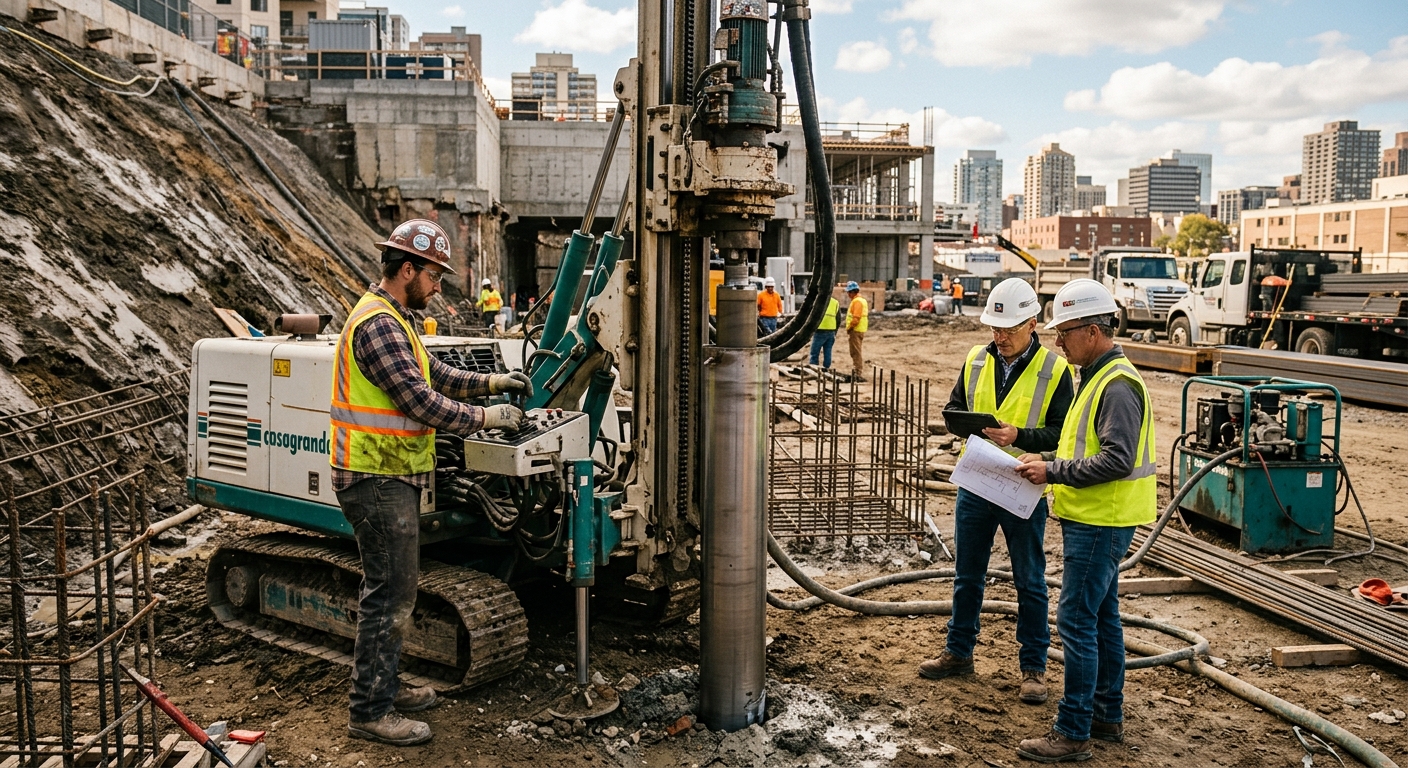
A capable micropile contractor should have access to a range of equipment, not a single rig type. That includes limited-access drills for low-headroom and tight-footprint work, conventional crawler-mounted rigs for open sites, and the support equipment needed for grouting and load testing.
Mobilization speed also matters. When micropile work sits on the critical path, a contractor who can mobilize quickly protects your schedule. Ask about typical mobilization timelines, regional equipment availability, and how the contractor staffs projects. A contractor with a single crew and one rig may not be able to absorb schedule pressure or respond to a condition change without delaying your job.
Review Safety Performance and Field Quality
Micropile installation involves drilling, high-pressure grouting, heavy equipment, and often work in confined or active environments. Safety performance is a direct indicator of how a contractor runs its work.
Ask for the contractor’s Experience Modification Rate, their recordable incident rate, and any safety recognition they have earned. A contractor who cannot speak clearly about their safety program or who treats safety as a paperwork exercise is a liability on a complex site.
Field quality is equally important. Micropiles are hidden elements. You cannot visually inspect the finished product the way you can a retaining wall or a structural frame. That makes load testing, grouting records, and installation documentation critical. Ask how the contractor handles proof tests, verification tests, and production pile testing. Ask how they document grout pressures, drill logs, and pile locations. A contractor with disciplined field documentation gives you the records you need to defend the work to the owner, the engineer of record, and any third-party inspector.
Assess Communication and Responsiveness
On a complex project, conditions change. The geotechnical report misses something. Access changes because another trade fell behind. The owner adds scope. How a contractor responds to those changes tells you a lot about what it will be like to work with them.
Pay attention to how the contractor communicates during the bidding and preconstruction process. Do they return calls promptly? Do they ask informed questions about your project? Do they flag potential risks before you sign? Contractors who are responsive and direct before they have the work tend to stay that way after they have it. Contractors who are hard to reach during pursuit rarely become easier to reach during execution.
Talk to their references about communication. Ask whether the contractor kept them informed, responded quickly to field issues, and worked well with other trades. A technically strong contractor who communicates poorly can still create problems on a fast-moving job.
Understand How They Handle Unexpected Conditions
Complex projects almost always produce surprises. The question is not whether the contractor will encounter difficult ground. The question is how they respond when they do.
Ask the contractor to describe a project where conditions did not match the geotechnical report. Listen for how they identified the problem, how quickly they adjusted, and what they did to keep the project on track. A contractor who can speak to specific examples of adapting to field conditions is one who has been tested under pressure.
Also ask how they handle design changes. Do they have the engineering capacity to modify the pile design in the field, or do they need to stop work and wait for an outside engineer? The ability to adjust design and installation in real time is one of the main advantages of working with a design-build micropile contractor. If that capacity is not there, you lose the benefit.
Verify Capacity to Handle Your Project Size
Some micropile contractors are well suited to small, routine work. Others are built for large, complex projects with significant scope and schedule demands. Make sure the contractor you choose can handle the scale of your job without overextending.
Ask about current and recent project sizes. Ask how many crews they can dedicate to your project. Ask how they manage workload during peak periods. A contractor who is already stretched thin may not be able to give your project the attention and resources it needs.
This is not about size for its own sake. It is about whether the contractor has the depth to absorb the demands of a complex project without compromising quality, safety, or schedule.
A Practical Evaluation Checklist
Before you make a selection, confirm the contractor can answer yes to the following:
- Do they have in-house engineering and design-build capability?
- Can they show experience on projects with similar site conditions and constraints?
- Do they engage in preconstruction and offer value engineering support?
- Do they have the equipment range to handle your access conditions?
- Can they mobilize within your schedule requirements?
- Do they have a strong, documented safety record?
- Do they perform and document load testing to industry standards?
- Can they provide references from general contractors on comparable projects?
- Do they communicate clearly and respond quickly during the pursuit phase?
- Can they adjust design and installation when field conditions change?
The Bottom Line
Evaluating micropile contractors for complex projects comes down to one question. Can this partner solve problems under pressure without putting your schedule or your risk profile at risk? Technical capability, field experience, design-build integration, safety discipline, and communication all factor into that answer.
The right contractor brings engineering insight and field execution together. They help your team anticipate ground conditions, value engineer the foundation, and keep the work on schedule. The wrong contractor turns every unexpected condition into a delay.
Take the time to evaluate partners against the criteria that matter on your project. The effort you invest during selection pays back in fewer surprises, stronger documentation, and a foundation that performs the way it was designed to.